Funny Faces Coloring Pages for Kids
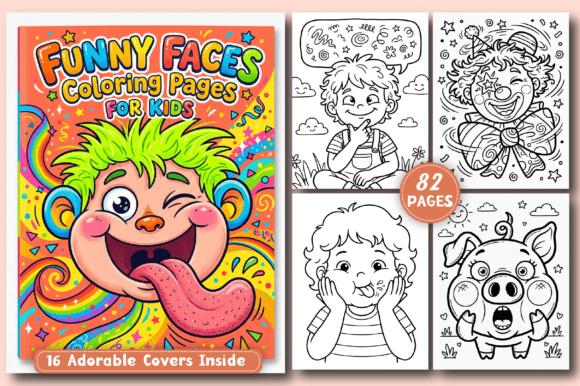
Funny Faces Coloring Pages for Kids is a themed activity book collection designed to offer children a playful and engaging coloring experience centered on exaggerated, silly, and goofy facial expressions. The bundle in question, Funny Faces Coloring Pages For Kids 82 Silly Goofy Designs, provides 82 distinct pages featuring characters such as clowns, animals like a surprised pig, and other whimsical figures with over-the-top expressions. The product is formatted for Amazon KDP interior uploads, printable use, and classroom or daycare settings, and includes a range of file types (PDF, PNG, JPG) at 300 DPI resolution in A4 size. Accompanying the coloring pages are 16 cover designs that can be mixed and matched freely.
For anyone evaluating this resource—whether as a parent, teacher, caregiver, or self-publisher—the central question is whether this specific approach to coloring pages aligns with the needs of the children who will use them and the goals of the adult selecting them. This article provides a practical, objective look at what the product offers, when it works well, and when alternatives might be worth considering.
What Makes Funny Faces Coloring Pages Distinctive
At its core, Funny Faces Coloring Pages for Kids focuses on one particular element of character design: the face. Instead of generic scenes, landscapes, or patterned mandalas, each page centers on a character whose expression is the main feature. This could be a clown with an exaggerated grin, an animal with bulging eyes, or a figure with a comically confused look. The emphasis is on variety in emotion and silliness rather than on narrative or detailed backgrounds.
The 82-page collection offers a substantial volume of content, which is useful for repeated use across multiple sessions or for sharing among a group of children. The inclusion of 16 cover designs adds flexibility for those who plan to compile the pages into a book or offer them as separate themed packs. The print-ready specifications (300 DPI, A4 size, multiple file formats) mean that users can print at home, at a print shop, or upload directly to a print-on-demand platform without needing to adjust resolution or layout.
Why Parents and Educators Consider This Type of Resource
Coloring activities remain a staple in many households and classrooms because they support several developmental areas simultaneously. Fine motor skills improve as children learn to control crayons, markers, or colored pencils within defined lines. Focus and patience develop as a child works through a page from start to finish. Creative decision-making comes into play when choosing colors and considering how to represent an emotion or character.
Funny Faces Coloring Pages for Kids adds an element of humor to these benefits. The goofy expressions are designed to prompt laughter and curiosity, which can make the activity feel more like play than work. For children who are reluctant to color or who find standard pages boring, the humorous content may increase engagement. Teachers have noted that when children find an activity amusing, they are more likely to stay with it longer and return to it voluntarily.
Another reason this type of resource attracts interest is its suitability for a wide age range. While younger children (ages 3–6) may focus on the simple joy of filling in large areas with bright colors, older children (ages 7–10) may enjoy the challenge of matching colors to moods, creating their own funny faces, or even inventing backstories for the characters. This adaptability means that a single purchase can serve multiple children at different developmental stages.
Benefits and Strengths of This Approach
One of the most notable benefits is the emotional literacy that can develop through coloring faces. When a child colors a surprised pig or a sad clown, they are engaging with the concept of emotions in a low-pressure, visual way. A parent or teacher can ask, “What do you think this character is feeling?” or “What color do you use when someone is surprised?” These conversations build vocabulary around emotions and help children recognize facial cues in real life.
The silliness factor also serves as a natural stress reliever. Many children face pressure from school, social dynamics, or extracurricular schedules. Coloring a deliberately ridiculous face can be a safe outlet for tension. The act of choosing bright, unconventional colors for a clown's nose or a pig's cheeks allows for self-expression without the fear of getting it “wrong.” There is no correct way to color a goofy face, and that freedom is valuable for building confidence.
From a practical standpoint, the product’s formatting is a clear strength. The 300 DPI resolution ensures crisp lines when printed, which is important for keeping young colorists within the boundaries. The A4 size provides enough space for detail without being overwhelming. The availability of PDF, PNG, and JPG formats means that users can work with whatever software or printing service they prefer. For KDP publishers, the 16 cover designs save time and offer variety for different listing strategies.
Tradeoffs and Limitations to Consider
While Funny Faces Coloring Pages for Kids has clear strengths, it is not a universal solution. One tradeoff is the singular focus on faces. Children who prefer narrative scenes, animals in natural settings, or intricate patterns may lose interest after a few pages. The repetition of the “face” theme, even with varied expressions, can feel limiting over time. A child who loves dinosaurs or princesses may not connect with a book full of clowns and surprised animals.
Another consideration is the level of detail. Some pages may feature relatively simple outlines, which is ideal for younger children but may not challenge older or more advanced colorists. Conversely, pages with more intricate facial features (wrinkles, teeth, multiple expression lines) may frustrate a child who is still developing fine motor control. It would be helpful to preview a few sample pages before purchasing to gauge whether the complexity matches the intended user.
There is also the question of cultural or personal sensitivity. While most children enjoy silly faces, some may find certain exaggerated expressions unsettling. Clowns, for example, are beloved by many but can be frightening to a small percentage of children. Similarly, exaggerated teeth or bulging eyes might be perceived as scary rather than funny by a sensitive child. Parents and educators should consider the temperament of the child before introducing these pages.
For those using the pages in a classroom or group setting, the single-theme nature means that not every child will be equally engaged. Having a variety of coloring options available (some funny faces, some scenes, some patterns) may be a better strategy for group activities where individual preferences vary widely.
When Funny Faces Coloring Pages Are a Strong Fit
This resource is particularly well-suited for several specific scenarios. First, it works well as a supplemental activity during holidays, birthday parties, or family gatherings. The humorous content can serve as an icebreaker among children who do not know each other well. Coloring together at a table with funny face pages naturally invites laughter and sharing.
Second, it is a strong fit for therapists, counselors, or special education professionals who work on emotional recognition and expression. The pages provide a structured yet playful way to talk about feelings. A therapist might ask a child to choose a page that shows how they feel today, or to color an emotion they want to learn more about. The non-threatening nature of the goofy designs can lower defenses and open up conversation.
Third, self-publishers who are looking for a niche within the crowded coloring book market may find that Funny Faces Coloring Pages for Kids fills a specific gap. Many coloring books focus on animals, princesses, or vehicles. A dedicated funny faces book stands out and can attract buyers searching for humor-based educational tools. The included cover designs and print-ready files reduce production time and technical barriers.
Fourth, parents of children who already enjoy drawing faces or making funny expressions will likely find this product highly engaging. It validates an interest the child already has and provides fresh material for them to explore. It can also be a parent-child bonding activity where both color their own pages and compare results.
When Alternatives May Be Worth Considering
There are situations where a different type of coloring resource may serve better. If the goal is to build fine motor skills through more intricate work, a mandala or detailed pattern book would offer greater challenge. If the child is passionate about a specific theme (space, dinosaurs, ocean life), a topic-specific coloring book will likely hold their attention longer than a general funny faces collection.
For classroom teachers who need to align activities with curriculum topics, a funny faces book may feel tangential unless it is specifically used for a lesson on emotions or self-portraits. A teacher covering a unit on animals, for example, would benefit more from a realistic animal coloring book than from a book of goofy-faced pigs and clowns.
Children who prefer quiet, calm activities might find the silly expressions overstimulating. For these children, nature scenes or simple pattern coloring may be more soothing. Similarly, children who are very literal or who struggle with abstract concepts may not understand why a face looks “silly” and may become frustrated rather than amused.
Another alternative worth considering is a mixed-theme coloring book that includes funny faces among other subjects. This provides variety while still offering some humorous content. A book with 30 pages of faces, 30 pages of animals, and 30 pages of scenes might offer more longevity for a single purchase.
Practical Decision-Making Insights
When evaluating whether Funny Faces Coloring Pages for Kids aligns with your goals, start by considering the child's personality and interests. Does the child enjoy humor and silliness? Do they like drawing or coloring faces? Have they responded well to similar products in the past? If the answer to these questions is yes, this product is likely a good fit.
Consider also the setting in which the pages will be used. For one-on-one use at home with a child who appreciates humor, the collection offers excellent value. For a classroom with 20 students of varying interests, a broader selection of themes would be more practical. In that case, you might use the funny faces pages as one station among several during a centers-based activity.
Look at the sample pages carefully before purchasing. The level of detail, the variety of expressions, and the types of characters should match the child's age and ability. If you cannot find samples, consider reaching out to the seller or publisher for clarification. A product that looks promising in description may not deliver in practice if the art style or complexity does not match expectations.
Consider also the file format and resolution. The product is offered in 300 DPI print-ready formats, which is excellent for professional printing. If you plan to print at home, ensure your printer settings match the A4 size and resolution for best results. If you plan to upload to KDP, the included covers and interior files should save you significant setup time.
Final Considerations for Choosing
Funny Faces Coloring Pages for Kids offers a focused, humorous approach to coloring that can be highly engaging for the right child. Its strengths lie in emotional literacy, stress relief, creative freedom, and practical formatting. Its limitations include a narrow thematic focus, potential sensitivity issues, and varying levels of detail that may not suit every child.
The best decision comes from matching the product to the user. A parent whose child already loves making funny faces at the dinner table will likely see that enthusiasm carry over into coloring time. A teacher looking for a one-size-fits-all classroom resource may need to supplement with other themes. A self-publisher will appreciate the ready-to-upload format and cover variety, but should ensure that the niche aligns with their target audience.
Coloring remains a valuable activity for childhood development, and humor adds an extra layer of engagement. Whether this specific collection is the right choice depends on the child, the context, and the goals you have in mind. By weighing the benefits against the tradeoffs, you can make an informed decision that serves the young colorist well.